
Giving deeper possibilities of life experimental form
Deeper Life Living Lab
The Deeper Life Living Lab is where the wider inquiry of Harmony Nexus encounters life through experimentation.
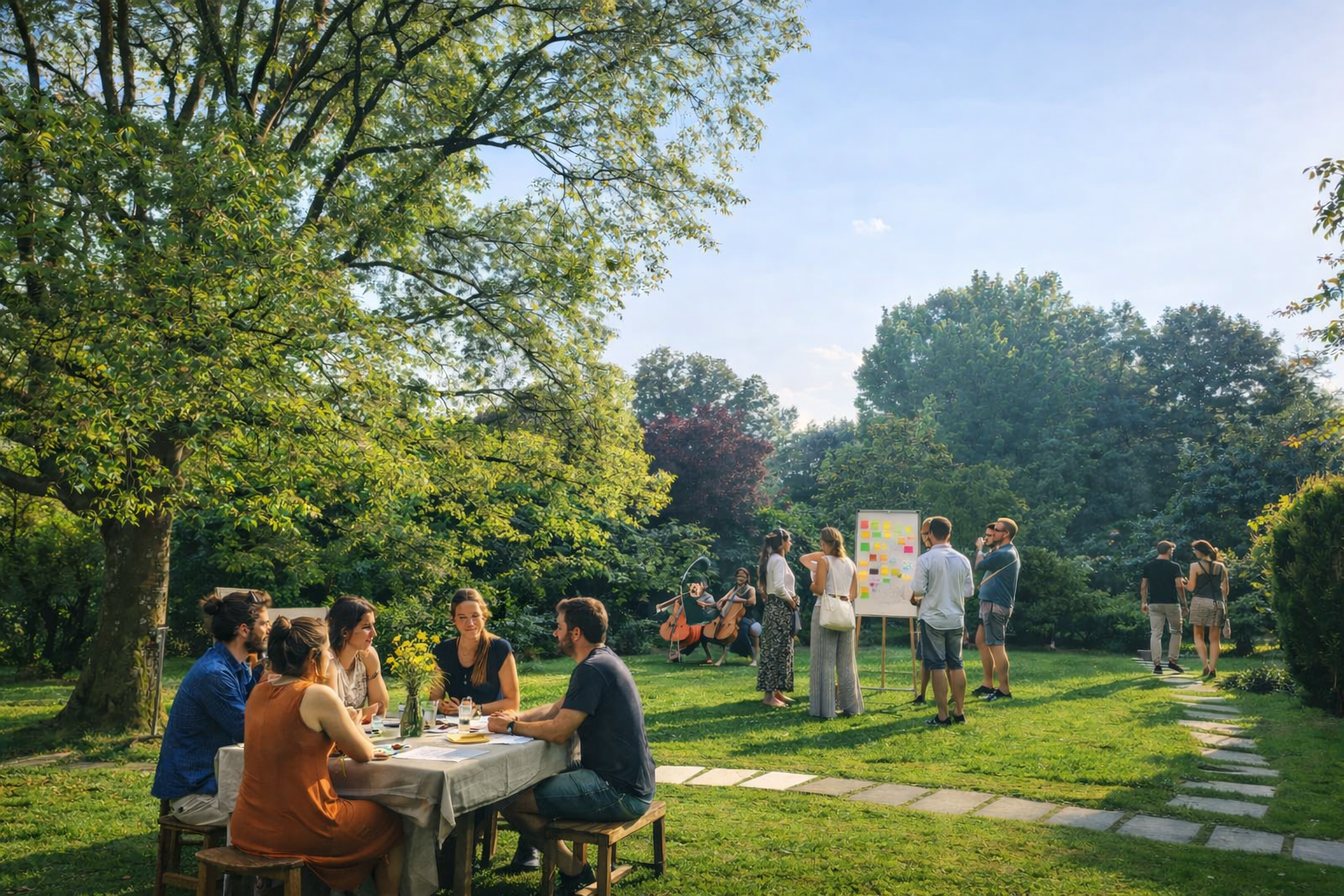
It grows from a living experimental environment near Venice and extends through collaborations with other places, ecologies, institutions and fields.
Rather than remaining only at the level of ideas, the Lab creates conditions through which questions about relation, matter, ecology, form, rhythm, transformation and participation can become tangible and unfold over time.
It is not a finished model of how life should be.
It is a place for exploring what might become possible under different conditions.
A laboratory within life
We approach experimentation as participation within living fields, rather than observation from outside them.
A field may bring together organisms, materials, technologies, atmospheres, histories, rhythms, meanings and other participants. Changing one condition can alter relationships and possibilities elsewhere.
The interest is therefore not only in what an intervention produces immediately, but in how relationships transform, what new qualities or capacities emerge, and what the wider field becomes capable of next.
From possibility to manifestation
The Living Lab gives promising questions and propositions experimental form.
An exploration might involve a material or spatial configuration, an ecological intervention, sound or vibration, light and sensory conditions, rhythm, technology, an installation, an Ignitor, or a collaboration across disciplines.
The format follows the question.
We are interested both in possibilities that may already be latent within a field and in those that may emerge only through new configurations of relation.
The aim is not simply to prove an idea, but to explore:
What deeper qualities or possibilities can become manifest here — and what do they make possible in turn?
Sensing what emerges
Different transformations reveal themselves differently.
Some may be material or physical. Others biological or ecological, relational or experiential. Some only become visible through repetition, adaptation, accumulation or time.
We therefore bring together different forms of sensing — from observation and measurement to lived experience, participatory interpretation and other field-appropriate approaches.
No single form of evidence is assumed to capture the whole.
What matters is following how transformation moves through a field and whether something changes not only in the immediate outcome, but in its future capacities and possibilities.
An evolving and distributed Living Lab
One of the first focused pathways being developed through the Lab is Relational Metabolism and metabolic depth: exploring how relations transform what is present, what distinguishes qualitative depth from change alone, and how those transformations may open richer possibilities of life.
But the Living Lab is larger than any one framework.
Its physical home provides a place for sustained experimentation, while other questions may require different living fields — a landscape, cultural institution, technological environment, building, territory or ecological site.
The Lab is therefore both rooted and distributed: a home for experimentation and a growing constellation of real-world fields explored with partners.
An open inquiry
The Deeper Life Living Lab is intentionally unfinished.
Questions evolve. Experiments challenge assumptions. Some propositions deepen; others change or disappear.
Its purpose is not to demonstrate a predetermined vision of deeper life, but to create conditions through which greater depth, richness and possibility might become manifest — and to discover what life can become capable of as a result.
We welcome conversations with researchers, practitioners, institutions and other curious partners interested in bringing meaningful questions into experimental relationship with real living fields.
Curious to explore how we may co-explore?